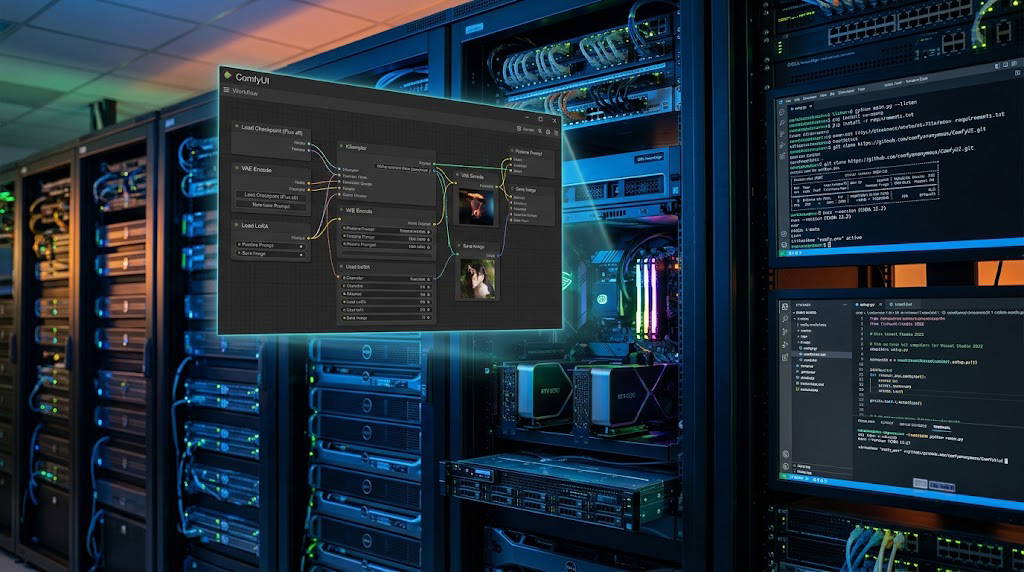
ComfyUI Advanced
Duration
8 hours of remote training.
When
4 meetings of 2 hours each (balanced between explanation and assisted practice) on: September 29, 2026 at 9:00 PM CEST | October 1, 2026 at 9:00 PM CEST | October 6, 2026 at 9:00 PM CEST | October 8, 2026 at 9:00 PM CEST
Class
Max. 20 students
Price
59 € +
VAT
Course starts on September 29, 2026
Behind every great workflow is a perfectly configured server. This advanced course is for those who want to master ComfyUI from a system and architectural perspective. We won't talk about prompts or artistic styles: you'll learn how to set up an isolated production environment from scratch, install and configure the Studio compilers, map the correct libraries, and manage packages via and virtual environments. We'll tackle troubleshooting library conflicts and surgically optimize VRAM to handle massive models (like Flux or SD3) without crashing.
Note: The course will only start with a minimum of 8 participants.
BY FOLLOWING THIS COURSE YOU WILL BE ABLE TO:
By the end of this 8-hour course, you will have developed complete operational autonomy on the fundamental flows of ComfyUI. Specifically, you will be able to:
🛠️ Configure and Isolate the Environment (SysAdmin Foundations)
Build the server from scratch: Saprai installare ComfyUI in modo nativo tramite Git, abbandonando per sempre le versioni pre-compilate ("Portable") per avere il controllo totale sui file sorgente e sugli aggiornamenti.
Isolate processes with Virtual Environments: You will be able to create and manage Python virtual environments (
venv), avoiding destructive conflicts between ComfyUI libraries and global operating system libraries.Aligning the hardware pipeline: You will learn how to properly map the technical trinity of AI computation (NVIDIA Drivers ➡️ CUDA Toolkit ➡️ PyTorch) to ensure that your system takes full advantage of GPU hardware acceleration.
🌋 Solving Dependency Hell (Advanced Troubleshooting)
Building Complex Nodes in C++: You will know how to configure and use the Visual Studio Build Tools to manually build critical packages and extensions (such as InsightFace, XFormers or FlashAttention) directly on your machine.
Debugging crashes from the terminal: When faced with a critical error in the console (e.g. ModuleNotFoundError or PIP version conflicts), you will know how to read the logs and the
requirements.txtfiles to intervene surgically and unblock the server.Managing Versioning with Git: You will know how to use basic Git commands (
pull,checkout,reset) to perform a targeted downgrade or update of a single custom node that broke the workflow after an update.
💾 Optimize Resources and Storage (Hardware Engineering)
Centralize Models (Zero Duplicates): You will know how to configure the
extra_model_paths.yamlfile and use symbolic links (Symlinks) at the file system level to share terabytes of checkpoints with other UIs (e.g. Automatic1111, Forge), even moving large files to network NAS or secondary disks.Squeezing VRAM to the limit: You will learn to master the command line boot arguments (
--highvram,--lowvram,--fp8_e4m3fn,--gpu-only) to run very heavy next-generation models even on commercial video cards, eliminating the infamous Out Of Memory (OOM)errors.
🤖 Automate and Leverage ComfyUI as a Microservice
Launch ComfyUI in Headless Mode: You will know how to start the server in the background, disabling the graphical interface to manage remote renderings or configurations on distributed cloud servers.
🎯 In summary: You will become the indispensable technical figure who solves problems when everything stops. You will no longer be a simple user of artificial intelligence, but an AI Pipeline Engineer capable of designing, optimizing and maintaining stable, fast and automated enterprise production environments.
ARE THERE ANY REQUIREMENTS OR PREREQUISITES FOR THE COURSE?
Having attended the Intermediate Course (or equivalent knowledge): Students must already know what ComfyUI is and how logic flows work. We will not explain what a KSampler is or what a LoRA is used for; we will assume that they already know how to use the interface.
A PC configuration with internet access and a dedicated NVIDIA video card with at least 6GB of VRAM is required.
TO WHOM THIS COURSE IS ADDRESSED:
1. System Administrators, DevOps, and IT Specialists
If your company or team needs to implement ComfyUI on local workstations or Cloud instances (AWS, RunPod, Vast.ai), this course will give you the skills to configure scalable production machines, isolating environments and preventing an automatic update from blocking the work of the creative team.
2. Developers and AI Pipeline Engineers
If your goal is to integrate the generation power of Stable Diffusion or Flux within proprietary software, a website, or a business automation pipeline. You will learn to extract flows in JSON API format and communicate with ComfyUI in headless mode (without a graphical interface) via external scripts.
3. Technical Director of Creative Studios and Agencies
If you manage the hardware of an animation studio, VFX studio, or advertising agency. You'll be able to centralize model management (preventing each designer from downloading 50GB of duplicate files to their own PC thanks to Symlinks and shared paths) and will be able to immediately troubleshoot when community nodes conflict.
4. Power User "Stufi dei Crash"
If you use ComfyUI extensively for your projects and are tired of the pre-packaged "Portable" version, which mysteriously breaks every time you try to install an advanced node from GitHub, here you'll learn how to take full responsibility for your Python environment.
THE PROGRAM
1. System Administrator Setup (Git, CUDA, and Virtual Environment)
The goal of this lesson is to set up a clean, isolated server environment from scratch, learning how to perfectly align hardware drivers with Python's software architecture.
2. Advanced Custom Nodes and Dependency Hell
Learn how to install complex nodes bypassing the Manager and develop diagnostic skills to resolve classic compilation errors and library conflicts.
3. Storage Engineering, Symlinks, and VRAM Optimization
Optimize hard disk space by eliminating duplicate files and configuring server startup parameters to handle massive models (e.g., Flux or SD3) without environmental crashes.
4. Automation, Headless Mode
Transform ComfyUI into an automated backend microservice, detaching it from the browser GUI to integrate it into business pipelines.